What Is an AI Agent? The Complete 2026 Guide
Table of contents
- 1. What Exactly Is an AI Agent? (The Jargon-Free Version)
- 2. Anatomy of an AI Agent: What’s Under the Hood
- 3. Use Cases: Why Everyone’s Adopting Them in 2026
- 4. How to Build Your First Agent (The Tech Stack)
- 5. Watch Out for the Pitfalls! (What Nobody Tells You)
- Conclusion: Ready to Hire Your First Agent?
An AI Agent is an autonomous software system that perceives its environment, reasons, plans, and uses tools to achieve a goal without constant human intervention. Unlike traditional chatbots, it doesn’t just respond - it takes action. In 2026, AI agents are transforming productivity for SMBs and solopreneurs by automating repetitive tasks with an average ROI exceeding 400%.
Remember 2023? We were all amazed by ChatGPT writing poems in perfect meter. It was cute.
But this is 2026, and poems aren’t enough anymore. Today, we don’t just want to chat with AI - we want it to act. We want it to book that flight, sort through those 500 overdue emails, and follow up with that prospect who’s been ghosting us for three weeks.
Enter the real hero of our technological era: the AI Agent.
If you still think it’s just a slightly smarter chatbot, buckle up. You’re about to discover the difference between a trained parrot and an autonomous virtual employee.
1. What Exactly Is an AI Agent? (The Jargon-Free Version)
Imagine you hire an ultra-motivated intern.
- If you give them a precise list of instructions (“Do A, then B, then C”), that’s classic automation. It’s rigid. If one step fails, everything stops.
- If you tell them “Organize a seminar in Lyon for 50 people with a 5k budget,” and they figure out how to search for venues, compare caterers, and send invitations… That’s an AI Agent.
In simple terms: An AI Agent is a software system capable of perceiving its environment, reasoning to create an action plan, and using tools to achieve a goal autonomously.
For a deeper dive into the fundamental difference, check out our detailed comparison: AI Agent vs Chatbot: The Decisive Showdown.
2. Anatomy of an AI Agent: What’s Under the Hood
For an AI to become an “Agent,” it needs four magic ingredients. Think of it as equipping a brain (LLM) with arms and legs.
The Brain (LLM)
This is the reasoning engine (GPT-4o, Claude Sonnet 4, or open-source models like Mistral). It understands the request, analyzes context, and decides on strategy.
The Tools
This is what makes the agent “actionable.” Without tools, an LLM is just a brain in a jar. With tools, it can:
- Run a web search (Browsing)
- Send an email (Gmail/Outlook API)
- Update your CRM (HubSpot/Salesforce)
- Execute Python code
At Node6, our agents use Anthropic’s MCP (Model Context Protocol) to natively connect to your existing tools.
Memory
Unlike a script that starts from scratch every time, an agent remembers. It stores interaction history and user context so it doesn’t ask you the same thing 10 times.
Planning
When faced with a complex task (“Increase my sales by 10%”), the agent can break the problem into manageable subtasks: “1. Analyze current data, 2. Identify underperforming segments, 3. Draft an email campaign…“
3. Use Cases: Why Everyone’s Adopting Them in 2026
Adoption is exploding because the ROI of AI automation has become impossible to ignore. Here’s where they particularly shine:
For Solopreneurs & SMBs
Don’t have the budget for a 10-person team? An AI agent can handle:
- Your LinkedIn prospecting 24/7: Lead detection, personalized messages, automatic follow-up. That’s exactly what Zoe, our LinkedIn prospecting agent, does.
- Your social media presence: Content creation, scheduling, performance analysis. Alison, our Social Media Manager agent, handles this on autopilot.
- Your recruitment: CV screening, conversational qualification, interview scheduling with Magalie, our HR agent.
For Large Enterprises
- Analyst Agents: Monitor competition and market trends in real time.
- Coding Agents: Test code, write documentation, and suggest refactoring.
4. How to Build Your First Agent (The Tech Stack)
Good news: in 2026, you don’t need to be a Machine Learning engineer to get started. Two schools compete (or complement each other):
The No-Code / Low-Code School
This is the fast track for rapid prototyping. You connect visual building blocks. The showdown happens here: n8n vs Make: Which Platform for Your Agents?.
- Make (formerly Integromat): Ideal for linear workflows and simple connections.
- n8n: The favorite of tech enthusiasts for its flexibility and self-hosting capabilities (essential for data privacy).
The Code School (Frameworks)
For ultra-robust custom agents, the go-to frameworks are LangChain, LangGraph, or CrewAI (for multi-agent orchestration). This is the approach we use at Node6 to deliver production-grade agents.
5. Watch Out for the Pitfalls! (What Nobody Tells You)
Enthusiasm is great. Caution is better. Releasing an autonomous agent into the wild without guardrails is risky.
The “Actionable Hallucination” Challenge
If ChatGPT hallucinates a historical date in a conversation, it’s embarrassing. If your AI Agent hallucinates a 90% discount and sends it to your entire customer base, it’s a disaster. That’s why every Node6 agent includes guardrails and configurable human validation.
Compliance and Security
With agents autonomously handling customer data, the legal question is critical. In 2026, regulators aren’t messing around. Make sure you’re up to speed: AI and GDPR: The 2026 Compliance Checklist.
Conclusion: Ready to Hire Your First Agent?
AI Agents aren’t here to replace humans - they’re here to free them from “operational friction.” They handle the repetitive stuff, you handle the strategic stuff.
The question is no longer “Should I use AI agents?” but “Which process should I start with?”
The Expert’s Advice Don’t try to create the perfect agent that does everything on day one. Start with a “narrow” agent: one that ONLY sorts supplier invoices, for example. Once it’s reliable at 99%, give it a new skill. For a complete roadmap, follow our 30-Day Challenge.
Frequently asked questions
What is an AI Agent?
What's the difference between an AI Agent and a chatbot?
How much does an AI Agent cost in 2026?
Related articles
 AI Agents
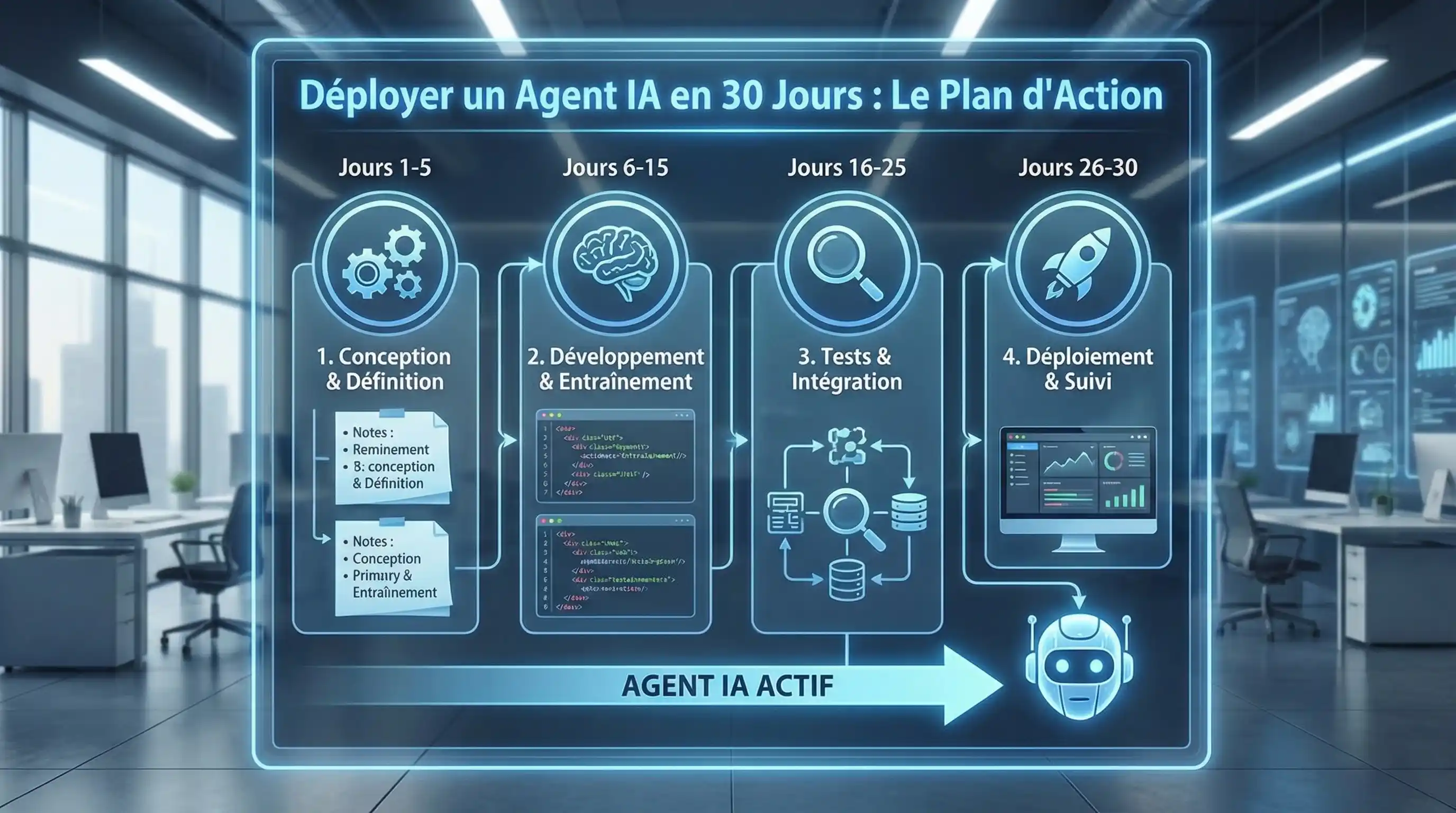
How to Deploy an AI Agent in 30 Days
You have 30 days to revolutionize your business. Here's the exact week-by-week roadmap to launch your first AI Agent.
 AI Agents
How to Calculate the ROI of Your AI Agents
Think AI is expensive? Wrong. Learn how to precisely calculate your automation ROI and prove it pays for itself in 30 days.
 AI Agents
Chatbot or AI Agent, What's the Difference?
Still confusing chatbots with AI Agents? Big mistake. Discover why one is a gimmick and the other is a virtual employee that actually boosts your business.
Stay up to date on AI
One email per month with the best AI insights for your business.
Unsubscribe in one click. GDPR compliant.