Best AI Agency in 2026: Comparison & Selection Guide
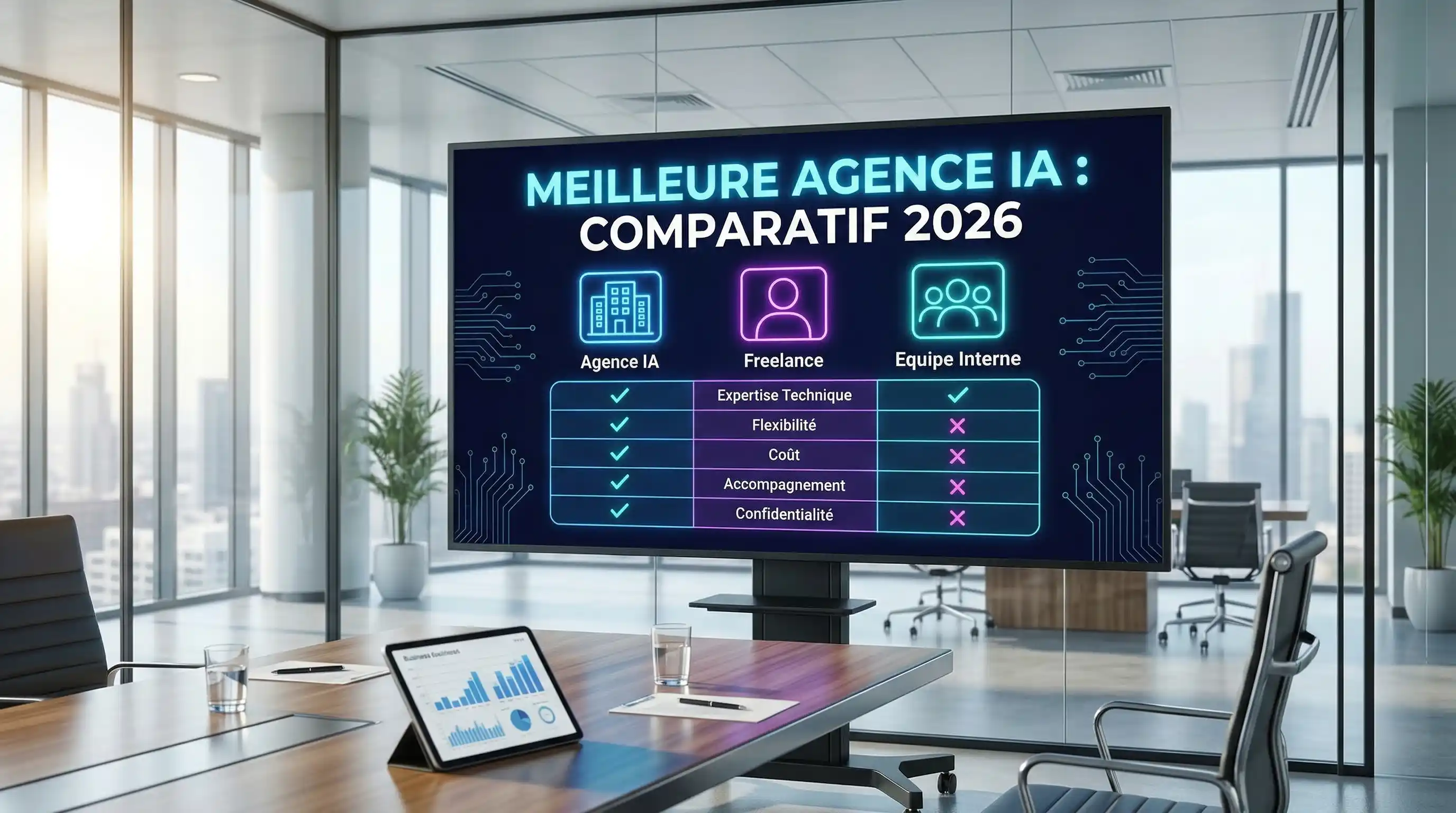
Table of contents
There is no universal “best AI agency” - the right choice depends on your industry, the complexity of your project, and your data maturity level. This guide lays out the objective criteria to evaluate and compare AI agencies in 2026, regardless of your context.
Type “best AI agency” into Google or ask ChatGPT. You get sponsored lists, self-proclaimed rankings, and pages that compare apples to oranges. Nothing useful for making a real decision.
The AI agency market has structured itself rapidly. In 2024, there were a handful of credible players. In 2026, there are hundreds. Pure-play AI shops, rebranded digital agencies, IT consulting firms that slapped “AI” onto their brochure, freelancers presenting themselves as agencies. How do you navigate this?
This guide will not give you an artificial “top 10.” It will give you concrete criteria to evaluate agencies yourself, a comparison table to choose the right format (agency, freelancer, or in-house), and the red flags that should make you walk away. Goal: arrive at your first meeting with the right questions.
The 6 Criteria That Separate a Good AI Agency from the Rest
Not all criteria are created equal. Here are the six that make the difference between an agency that delivers results and one that delivers slide decks.
1. Proprietary expertise vs subcontractor assembly
A good AI agency has developed its own methodologies, its own frameworks, its own agents. It does not simply assemble third-party building blocks without added value. Ask the question directly: “What have you built yourselves?”
If the answer boils down to “we use the OpenAI API with Zapier,” you are dealing with an integrator, not an AI agency. That is not necessarily a problem - but the pricing should reflect this reality.
2. Verifiable industry references
Client logos on a website mean nothing. What matters: detailed case studies with context, methodology, and measurable results. Not “we increased revenue by 300%,” but precise descriptions of what was done and what changed.
Ask to speak directly with a reference client. A serious agency will always agree.
3. Ability to deliver a POC in under 30 days
This is a decisive test. If an agency tells you 3 months before seeing a first working prototype, that is a red flag. A targeted POC - an agent that performs one specific task - can and should be delivered in 30 days.
This is exactly the methodology we detail in our guide on deploying an AI agent in 30 days. If your agency cannot keep this pace, ask yourself why.
4. Data hosting and sovereignty
In 2026, with GDPR and the European AI Act in full effect, the hosting question is no longer optional. Where is your data stored? In which country? With which cloud provider? Does data pass through servers outside the EU, even temporarily?
A serious agency has a clear, documented answer to these questions. If they hesitate or tell you “we’ll deal with that later,” walk away.
5. Post-launch support model
Deploying an AI agent is the beginning of the work, not the end. Language models drift. Business processes evolve. Users find unexpected edge cases.
Your agency must offer a clear maintenance model: monitoring, retraining, prompt updates, technical support. Verify that this is included in the contract or billed transparently. An agent delivered without ongoing support is a ticking time bomb.
6. Transparency on LLM models used
Claude, GPT-4o, Mistral, Llama - each model has its strengths and weaknesses. A good agency explains why it chose a specific model for your use case. It does not lock you into a single provider without a technical rationale.
Also ask about the data policy of the LLM being used. Some models train their algorithms on user data. For sensitive business data, that is a deal-breaker.
Comparison Table - AI Agency vs Freelancer vs In-House Team
Before searching for “the best AI agency,” ask yourself about the format. An agency is not always the right answer.
| Criterion | AI Agency | Freelancer | In-House Team |
|---|---|---|---|
| Initial cost | Medium-high | Low-medium | High (hiring) |
| Time to start | 1-2 weeks | Immediate | 3-6 months |
| Skill coverage | Broad | Narrow | Variable |
| Continuity | Contractually guaranteed | Availability risk | Strong |
| GDPR compliance | Varies by agency | Varies | Controlled |
| Long-term maintenance | Included (subscription) | Per quote | Included |
| Ideal for | Full projects, SMBs without IT dept | Short targeted missions | Enterprises, strategic projects |
The smart move: for an SMB with revenue between 500K and 15M euros, an AI agency is often the best trade-off. You do not have the resources to hire a full data team, and a solo freelancer cannot cover all the skills needed (strategy, development, data, maintenance).
To properly scope the budget, check our detailed guide on AI agency pricing and ROI.
Red Flags to Watch for During Your Selection
Certain signals should raise immediate alarm. Here are six, drawn from real-world feedback:
-
ROI promises with no calculation basis. “We guarantee 40% more productivity.” Based on what? With which assumptions? If the agency cannot show you its calculation model, those numbers are worthless. AI automation ROI is measured with rigor, not slogans.
-
No client references in your industry. An agency that automated customer service for an e-commerce store does not necessarily know how to handle the constraints of an audiology clinic or an HR firm. Industry expertise matters.
-
Exclusive dependency on a single cloud provider. If the entire solution relies on one provider with no alternative, you are in a lock-in situation. If that provider changes its pricing or policies, you are stuck.
-
No reversibility clause or data portability. What happens if you switch agencies in 12 months? Can you recover your data, your workflows, your prompts? If the contract does not address this, negotiate it before signing.
-
Strong sales team, vague technical team. Ask who will actually work on your project. Names, LinkedIn profiles, experience. If you are presented with a brilliant salesperson but the technical team remains a mystery, that is a problem.
-
Delivery timelines exceeding 3 months for a first POC. A POC is not a finished product. It is a targeted proof of concept. Three months for that is either a lack of competence or a broken internal process.
The 10 Questions to Ask at Your First Meeting
Come prepared. These ten questions will give you a clear picture of the agency in front of you:
-
Who on your team will actually write the code? You want names and profiles, not a vague answer.
-
Can you connect us with a client in the same industry? A refusal is a red flag. Hesitation too.
-
Which LLM do you use and why? The answer should be technical and well-reasoned, not “we use the best one on the market.”
-
Where is our data hosted during and after the project? You expect a precise answer: country, provider, certifications.
-
What is your timeline for delivering a first functional POC? The right answer is between 2 and 4 weeks.
-
How do you handle model drift in production? If the agency does not understand the question, they have never managed an agent in production.
-
What is your reversibility clause if we switch agencies? Data portability, code ownership, workflow transfer.
-
How do you calculate ROI and how do you measure it after deployment? You want a methodology, not a promise.
-
Do you have expertise on our existing stack (CRM, ERP, e-commerce)? Integration with existing tools is often the main friction point.
-
What is your pricing model for post-launch maintenance? Monthly subscription, annual package, per ticket - each model has its implications.
Why Node6 Stands Out in This Comparison
We do not claim to be “the best AI agency in the world.” We claim to be the best option for a specific profile: SMBs with revenue between 500K and 15M euros that want concrete results, not PowerPoint presentations.
Here is what sets us apart:
-
100% EU hosting (Frankfurt). Native GDPR compliance, not a patch added after the fact. Your data never leaves the European Union.
-
AI agents delivered as operational micro-SaaS products. Not a prototype that takes another 6 months to industrialize. Ready-to-run agents: Alison for social media, Julien for SEO, Sophie for e-commerce, Zoe for LinkedIn prospecting.
-
The Autopilot model. We do not hand you a tool and say “good luck.” We manage the outcomes. Your team does not need to become AI experts - that is our job.
-
SMB specialization. Large consulting firms charge hundreds of thousands of euros for audits that end up in a drawer. We deliver operational agents for a fraction of that budget. Discover our approach in detail on our custom solutions page.
-
Full transparency. Documented tech stack, explicit LLM choices, standard reversibility clause in all our contracts.
The Expert’s Advice Do not choose an AI agency based on an online ranking. Use the criteria from this guide, ask the 10 questions at your first meeting, and compare the answers. If you want to go through this exercise together, book a free diagnostic - 30 minutes to assess whether an AI agent can truly add value to your business.
Frequently asked questions
What are the key criteria for choosing the best AI agency?
Is an AI agency better than a freelance consultant?
How do you verify an AI agency's references?
Can European AI agencies compete with international ones?
Related articles
 AI Strategy
AI Agency: Custom Solutions for Your Business in 2026
Discover how an AI agency can transform your business with custom development, seamless integration into your systems, and GDPR-compliant infrastructure.
 AI Strategy
AI Agency Pricing in 2026: Models, Costs and Expected ROI
How much does an AI agency cost in 2026? Real price ranges, 3 pricing models, ROI calculation method and detailed Node6 packages. Complete guide for SMBs.
 AI Strategy
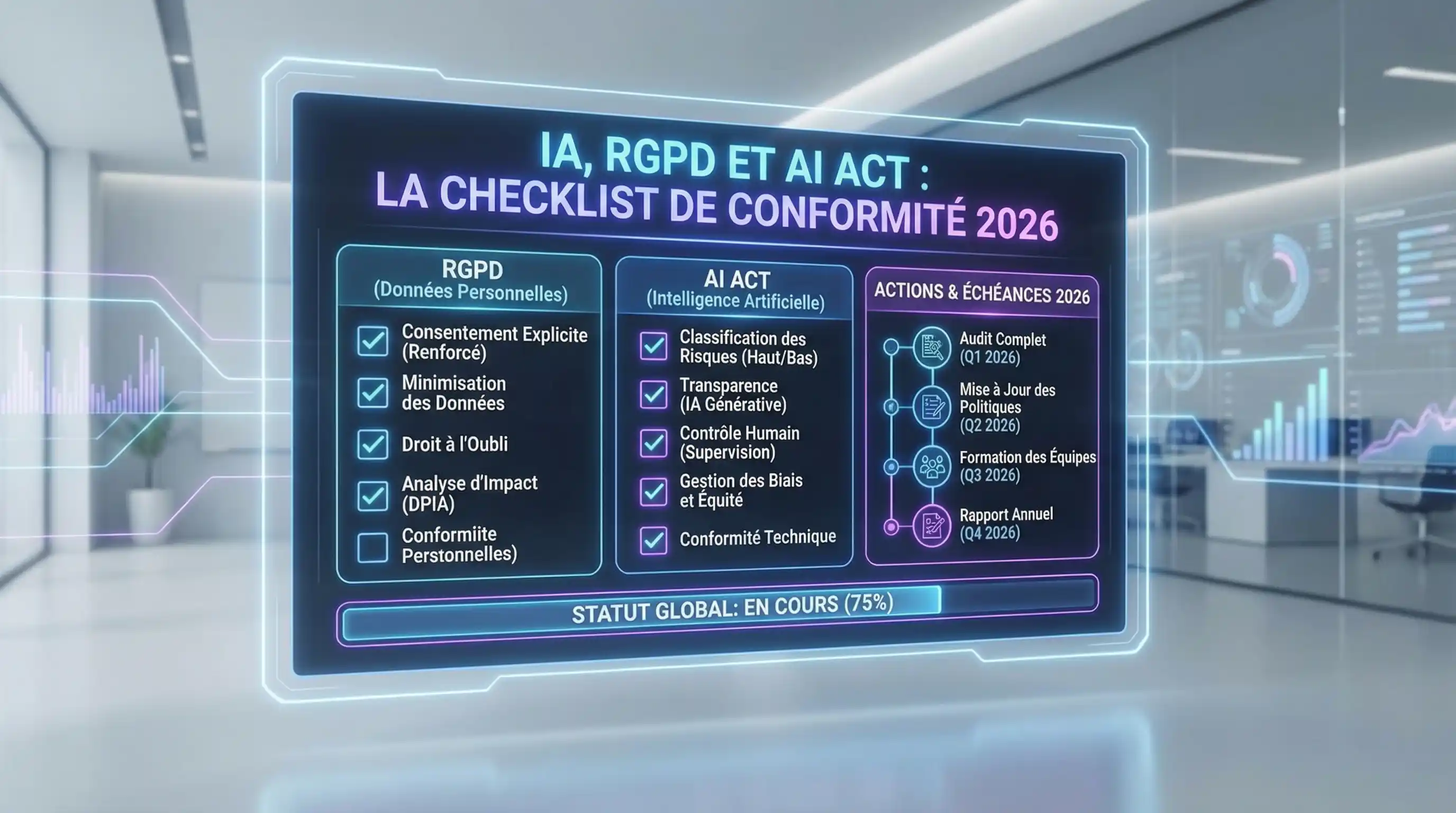
AI and GDPR, the 2026 Compliance Checklist
Worried the regulators will come knocking because of your AI Agent? Follow our 2026 checklist and sleep soundly.
Stay up to date on AI
One email per month with the best AI insights for your business.
Unsubscribe in one click. GDPR compliant.