Chatbot or AI Agent, What's the Difference?
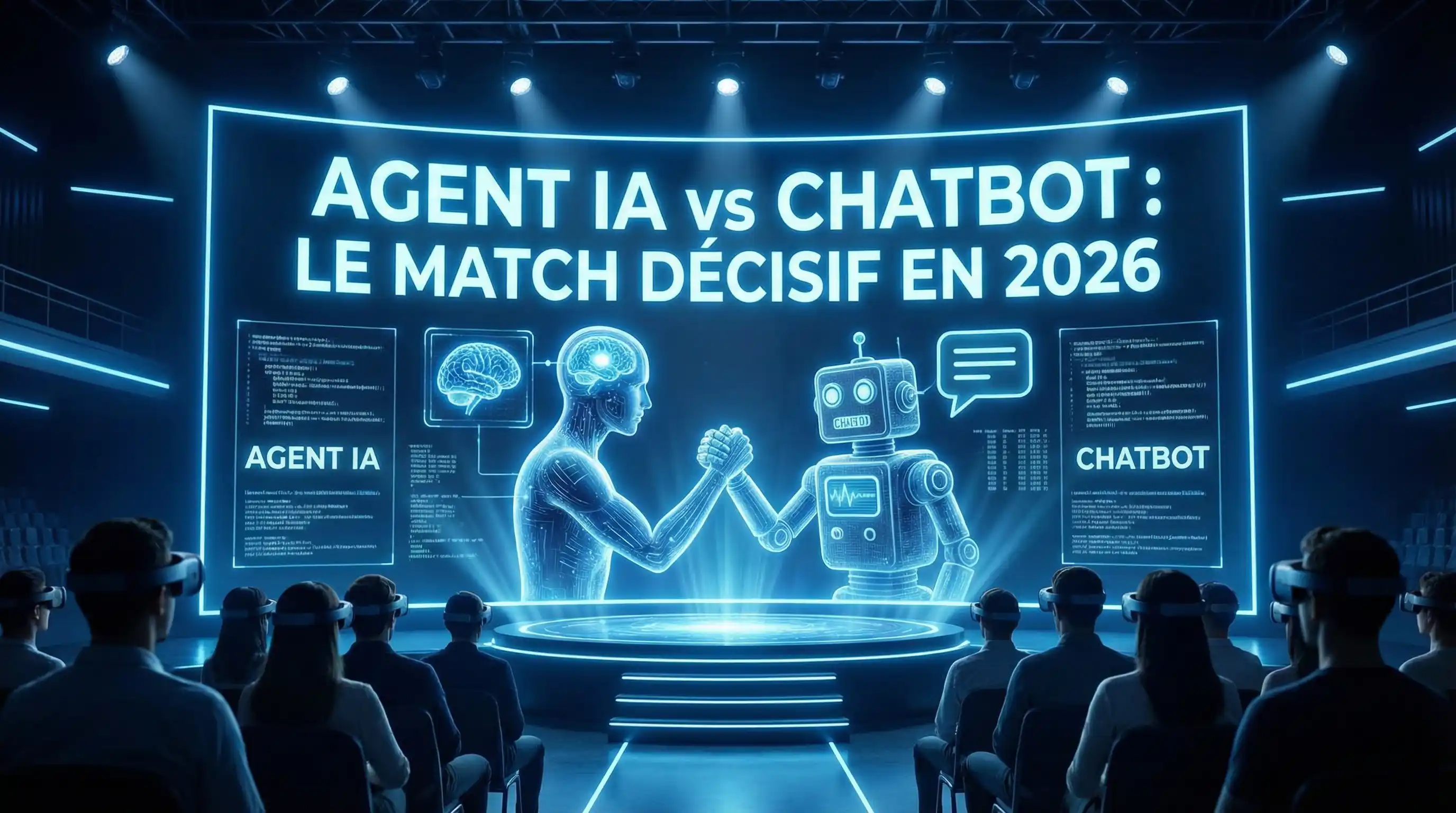
Table of contents
The difference between a chatbot and an AI agent comes down to one word: action. A chatbot follows a script and informs. An AI Agent understands, reasons, and executes tasks autonomously through API integrations. In 2026, the classic chatbot is an interactive bulletin board; the AI Agent is a hotel concierge who solves your problems.
A few years ago, having a little widget at the bottom right of your website that said “Hello, how can I help you?” was the pinnacle of tech.
Except 9 times out of 10, the conversation ended with: “Sorry, I didn’t understand your request. Would you like to speak to a human?”. Frustrating, right?
In 2026, that era is over. The classic Chatbot has given way to its big brother on steroids: the AI Agent. And trust me, the difference between the two is as big as the gap between a tricycle and a Tesla.
1. The Analogy to Understand Everything in 10 Seconds
To really grasp the nuance, imagine you walk into a hotel.
- The Chatbot is the interactive bulletin board in the lobby. You can press “Breakfast hours” and it shows “7am-10am.” If you ask “Can I get scrambled eggs?” it’ll probably answer “Error 404.” It’s passive and informational.
- The AI Agent is the hotel concierge. You tell them “I want scrambled eggs in my room in 20 minutes.” They call the kitchen, place the order, check that it’s ready, and send room service. They’re active and action-oriented.
For a complete technical definition of the Agent, check our guide: What Is an AI Agent? The Automation Revolution.
2. The 3 Fundamental Differences
Difference #1: Script vs Reasoning
A Chatbot follows a rigid decision tree (If A then B). It’s “If-This-Then-That.” If the user goes off-script, the bot is lost.
An AI Agent uses an LLM (Large Language Model) to understand the intent, even if it’s phrased oddly. It improvises and adapts.
Difference #2: Talk vs Action
This is the critical point. A Chatbot talks. It gives you a link or some information. An AI Agent acts. It has “arms” (API integrations). It can update a line in your CRM, fire a webhook, or generate a PDF.
That’s exactly the principle behind Cathy, our voice agent: she doesn’t just answer the phone - she books appointments, sends SMS confirmations, and updates the calendar.
Difference #3: Amnesia vs Contextual Memory
The classic Chatbot often forgets what you said 3 messages ago. The AI Agent maintains long-term context. It knows you’re the customer who had a delivery issue last week and adjusts its tone accordingly.
3. The Comparison Table
Here’s the summary to impress at your next board meeting:
| Criteria | Classic Chatbot | AI Agent |
|---|---|---|
| Mission | Inform & Direct | Solve & Execute |
| Flexibility | None (Scripted) | Total (Adaptive) |
| Integration | Limited (Website) | Deep (CRM, ERP, Email) |
| Initial Cost | Low | Medium |
| Added Value | Marginal time savings | Massive productivity |
| Memory | None or very short | Long-term context |
| Autonomy | Zero | High (with guardrails) |
4. Which One Should You Choose for Your Business?
Don’t throw out your Chatbot just yet. Each tool has its place.
Keep the Chatbot IF…
- You just need to answer the same 10 questions (Hours, Address, Pricing).
- Your budget is close to zero.
- You don’t want any connection with sensitive data.
Switch to an AI Agent IF…
- You want to automate a business process (e.g., “Qualify a lead and add it to the CRM”).
- You want to offer customer support that actually solves problems (e.g., “Refund this order”).
- You’re looking for measurable ROI. We’ve actually calculated that for you here: Calculate the ROI of AI Automation.
Conclusion: The Era of Action
The market has spoken: in 2026, passive assistance is no longer enough. Users want results, not conversations.
Replacing your old chatbot with an AI Agent is like replacing your receptionist with a business expert available 24/7. It’s an investment, sure, but it’s the kind that pays for itself in weeks.
The Expert’s Advice Start hybrid. Keep your chatbot for routine queries and plug in a specialized AI Agent as soon as a complex intent is detected (e.g., “I want to modify my reservation”). It’s the best of both worlds for keeping costs under control.
Frequently asked questions
What's the difference between a chatbot and an AI agent?
Should I replace my chatbot with an AI agent?
Related articles
 AI Agents
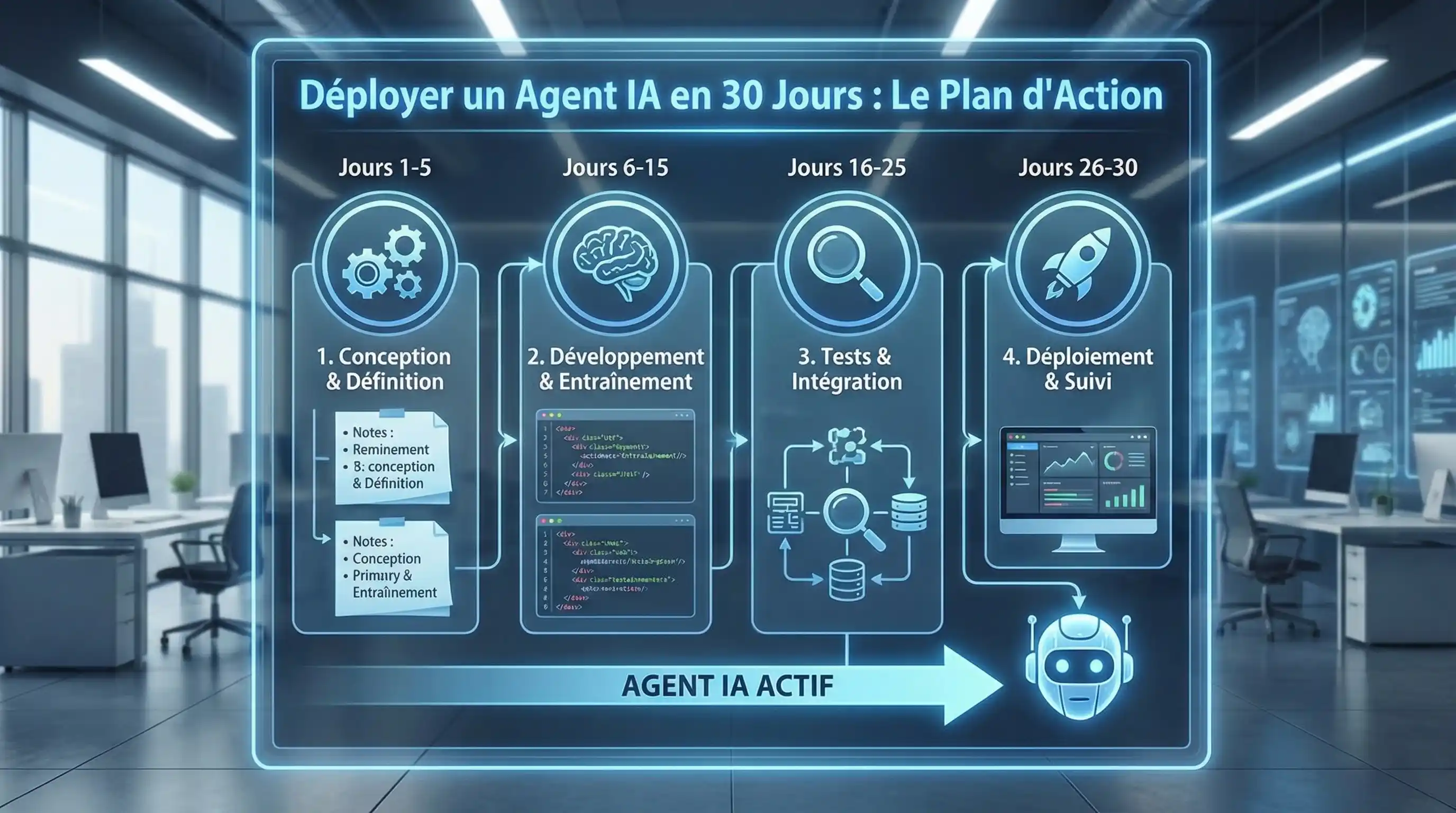
How to Deploy an AI Agent in 30 Days
You have 30 days to revolutionize your business. Here's the exact week-by-week roadmap to launch your first AI Agent.
 AI Agents
How to Calculate the ROI of Your AI Agents
Think AI is expensive? Wrong. Learn how to precisely calculate your automation ROI and prove it pays for itself in 30 days.
 AI Agents
What Is an AI Agent? The Complete 2026 Guide
Forget basic chatbots. Discover what an AI Agent really is, how it's revolutionizing automation in 2026, and how to integrate one into your business.
Stay up to date on AI
One email per month with the best AI insights for your business.
Unsubscribe in one click. GDPR compliant.